
Top AI Tools for Real Estate Agents: Automation Solutions
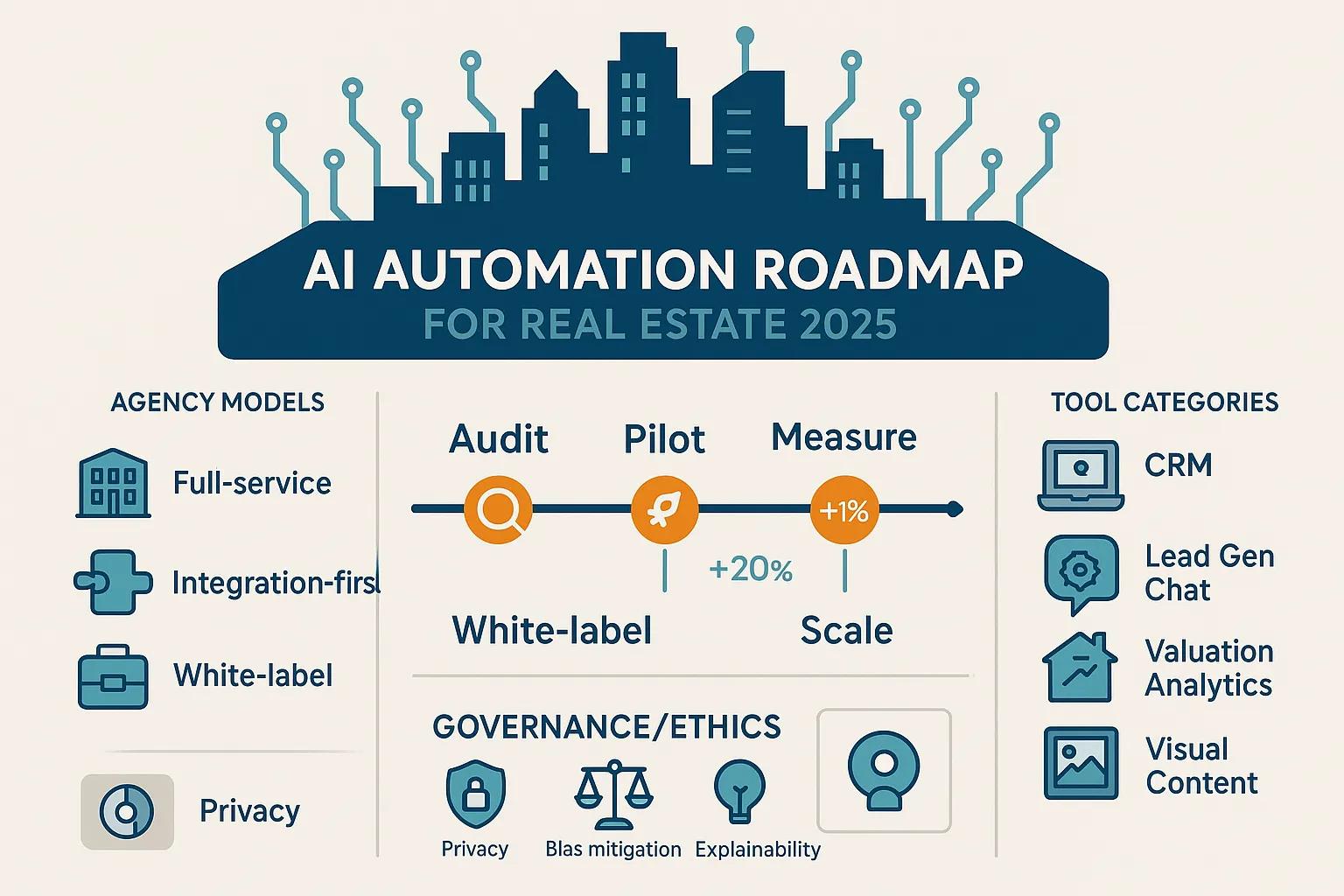
Top AI Automation for Real Estate — 2026 Playbook

AI automation agencies help real estate teams design and run AI-driven systems that automate lead capture, qualification, follow-up, and everyday workflows so agents can spend more time selling. They blend automation platforms, CRM integration, predictive analytics, and conversational AI to cut administrative work and lift conversion rates. This guide breaks down what these agencies actually do, which solution types matter in 2026, how to compare providers, and a practical roadmap for implementation with measurable KPIs. If you’re trying to increase lead conversion, shorten sales cycles, or scale personalized client outreach, you’ll find vendor-agnostic evaluation criteria, tool comparisons, and step-by-step implementation guidance for teams of all sizes. Throughout, we show how AI-powered CRMs, lead automation platforms, valuation models, and workflow orchestration fit together, why predictive analytics and NLP matter, and which governance steps protect data privacy and fairness. The sections that follow define services and benefits, outline agency service models, compare tools and platforms, present an implementation roadmap with an EAV tracking table, and close with trends and ethical guardrails relevant to 2026.
What Are AI Automation Agencies and How Do They Benefit Real Estate Agents and Teams?
AI automation agencies are specialist partners that design, implement, and run AI and workflow automation to streamline sales, marketing, and operations for real estate teams. They plug machine learning, natural language processing, and automation scripts into a team’s CRM and marketing stack so repetitive tasks run automatically and useful insights surface in real time. The main payoff is reclaimed time: less admin, more productive selling. Agencies also deliver repeatable playbooks so small teams get enterprise-grade automation without building models in-house—cutting time-to-value and reducing technical risk. With that foundation in place, the next section explains the specific efficiency and conversion mechanisms these agencies deploy.
AI automation produces measurable efficiency and conversion gains by applying targeted mechanisms to common real-estate workflows. Typical techniques include lead scoring that surfaces the highest-probability prospects, automated multi-channel follow-up that slashes response time, and 24/7 chatbots that qualify inbound interest outside business hours. When scoring feeds automated nurture, teams see faster handoffs and higher contact rates—often translating to conversion increases and shorter days-on-market. The next subsection maps the core technologies behind these results and the usual real-estate use cases they enable.
How Does AI Automation Improve Efficiency and Lead Conversion in Real Estate?
AI automation shifts routine work to systems—lead scoring, scheduling, and follow-up happen automatically—so agents can focus on high-value conversations and closing. Machine-learned lead scoring highlights prospects most likely to transact, enabling prioritized outreach that reduces time spent on low-probability leads. Automated follow-up sequences and chat qualification cut response times to minutes, preserve context across channels, and keep consistent contact cadences that move prospects through decision stages. Together, these capabilities lower administrative overhead, raise contact rates, and commonly deliver measurable lifts in conversion and agent productivity during early pilots.
Which AI Technologies Power Real Estate Automation Solutions in 2026?
In 2026 the core technologies powering real-estate automation are machine learning, natural language processing (NLP), computer vision, predictive analytics, and generative AI for content. Machine learning underlies lead scoring and price-prediction models that estimate buyer intent and property value; NLP powers chatbots and personalized messaging; computer vision supports virtual staging and automated listing-image quality checks. Generative models speed up listing descriptions and marketing copy, while predictive analytics turns market signals into actionable agent insights. Mapping each technology to real use-cases clarifies where to prioritize pilots and investment.
Which Are the Top AI Automation Agencies for Real Estate Teams in 2026?

Top agencies generally fit into three service models: full-service managed platforms, integration-first consultancies, and white‑label automation providers that plug into CRMs and marketing stacks. Choose a partner based on technical fit (CRM and MLS integrations), proven ROI, data governance practices, scalability for your team size, and their ability to transfer operational know-how to your staff. The comparison below helps match agency archetype to team needs; the EAV table that follows gives a quick reference for mapping strengths to typical requirements.
Agency TypeCore Service FocusBest ForFull-service managed platformEnd-to-end automation, model hosting, ongoing optimizationSmall-to-medium teams seeking turnkey solutionsIntegration-first consultancyCustom integrations, CRM tuning, data strategyTeams with complex legacy stacks needing tailored workWhite-label automation providerPrebuilt workflows, branded automation, rapid deploymentBrokerages and franchises wanting scalable replicas
That comparison highlights whether a provider emphasizes turnkey delivery, deep customization, or fast replication. Picking the right archetype reduces integration friction and shortens time-to-value—so the next section covers the evaluation checklist agents should use when vetting vendors.
What Criteria Should You Use to Choose the Best AI Automation Agency?
When you evaluate AI automation agencies, focus on technical compatibility, measurable outcomes, and responsible data practices. Key questions to ask: Does the agency integrate cleanly with your CRM and MLS? Can it show ROI with pilot metrics or case studies? How does it handle privacy and compliance? What training and support will your agents and operations team receive? Use these questions as a repeatable vendor checklist that prioritizes integration, security, and proof of impact.
Integration Fit: Confirm native or supported connectors for your CRM and MLS to avoid data silos.
Proof of Outcomes: Request pilot metrics, success criteria, and sample KPIs they track.
Data Governance: Verify policies for consent, secure storage, and model auditability.
Support & Training: Ensure hands-on onboarding and knowledge transfer are included.
These checks set the stage for understanding delivery differences across agencies and how each model scales with team size and technical maturity.
How Do Leading Agencies Compare in Services and Scalability?
Leading agencies differ by delivery model: managed services emphasize low-touch operations, consultancies deliver customization and skills transfer, and white-label providers enable rapid, brand-consistent rollouts across offices. Managed services reduce in-house maintenance but can create vendor dependence; consultancies offer flexibility but need stronger internal technical capacity; white-labels work best when consistent branding and fast scaling are priorities. Consider onboarding timelines, SLA guarantees, and tiered support—because scaling is as much about change management and training as it is about technology.
Managed services: Fast launch with ongoing optimization; ideal when teams want minimal operational overhead.
Consultancies: Tailored integrations and strategy; best when legacy systems require custom logic.
White-label providers: Rapid, standardized rollouts; best for brokerages scaling across offices.
Your chosen model will shape pilot scope, governance, and the rollout approach the roadmap later operationalizes.
What Are the Best AI Tools and Platforms for Real Estate Agents and Teams?

The most impactful tools fall into four categories: AI-powered CRMs, lead-generation and chat-qualification platforms, valuation and market-analytics engines, and visualization/content tools for listings. CRMs automate workflows and forecasting; lead platforms capture and qualify more inbound interest; valuation engines deliver predictive market insights; visualization tools improve listing presentation with virtual staging and image optimization. The compact table below maps categories to core features and common uses so teams can prioritize pilots that meet operational goals.
Tool CategoryKey FeaturePrimary UseAI-powered CRMAutomated lead scoring, workflow automationCentralized contact management and forecastingLead gen & chat platforms24/7 chat qualification, ad-to-lead automationRapid capture and initial qualification of inbound leadsValuation & analyticsPredictive price models, market segmentationPricing guidance and market strategyVisualization & contentVirtual staging, generative listing copyImproved listing presentation and faster content production
Use this table to choose pilots that solve immediate problems—whether that’s faster contact, more accurate pricing, or better listing presentation—before narrowing vendor and platform options.
Which AI-Powered CRMs Offer Advanced Features for Real Estate in 2026?
Advanced AI CRMs prioritize integrated lead scoring, automated nurture sequences, omnichannel messaging, and AI-driven forecasting to surface the best opportunities. The right CRM reduces manual entry, triggers nurture flows from behavior signals, and shows predictive dashboards indicating which leads or listings are most likely to convert. Integration matters: native MLS syncs, email and SMS channels, and connectors for ad and analytics platforms reduce friction. Compare feature parity and connector ecosystems to pick a CRM that becomes your central automation hub—not an isolated tool.
Prioritize CRMs with built-in lead scoring and multi-channel nurture capabilities.
Confirm connectors for MLS, ad platforms, and common marketing tools to avoid manual exports.
Evaluate forecasting features that translate lead behavior into pipeline-velocity insights.
How Do AI Lead Generation and Nurturing Tools Enhance Client Acquisition?
AI lead-gen and nurturing tools boost acquisition by combining targeted programmatic ads, conversational qualification, and behavior-driven nurture sequences that adapt timing and content to prospect signals. Programmatic platforms use lookalike and intent signals to feed higher-quality leads into chat and CRM flows; chat tools use NLP to capture context and route hot prospects to agents; nurture sequences re-engage leads with tailored messaging until they’re sales-ready. A common workflow: an ad click enters a chatbot for instant qualification, then moves into a nurture stream while priority leads are flagged for immediate human follow-up.
Targeted acquisition: AI refines audiences to lower cost-per-lead and increase intent.
Instant qualification: Chatbots capture essential data and route high-intent leads.
Adaptive nurture: Behavior-driven messaging raises conversion over time.
These lead-layer improvements feed CRMs and valuation models to create a closed-loop system that raises pipeline quality.
How Can Real Estate Teams Implement AI Automation Effectively?
Effective implementation follows a disciplined roadmap: audit workflows and data, prioritize the highest-ROI use-cases, run focused pilots, measure outcomes against defined KPIs, and scale with governance in place. Teams that start with a clear data and workflow audit avoid common integration pitfalls and pick pilots likely to show measurable wins—such as shorter response times or higher conversion for target segments. The roadmap below turns these ideas into phased actions your team can adapt, and the EAV table helps assign owners and outcomes for each stage.
PhaseOwnerOutcome (KPI / Timeline)Audit & objective-settingTeam lead + operationsClear use-case list and baseline KPIs (2–4 weeks)Pilot build & launchImplementation partnerPilot live with tracked metrics (conversion lift, response time) (4–8 weeks)Measurement & optimizationData analyst / vendorReported KPI delta and optimization plan (2–4 weeks)Scale & governanceOps manager + ITOrganization-wide rollout with SLAs and monitoring (8–12 weeks)
This implementation table aligns owners, timelines, and outcomes so teams can justify incremental investment and scale confidently. The next subsection outlines stepwise activities for building the roadmap and example KPIs to track.
What Are the Steps to Develop an AI Automation Roadmap for Real Estate?
Start with a workflow and data audit to surface where automation will cut friction and increase conversion. Prioritize pilots that have clear ROI and are feasible with existing data and integrations. For each pilot, define success metrics—conversion-rate lift, average response latency reduction, or percent of administrative hours reclaimed—and run the pilot using A/B testing or pre/post measurement. After a successful pilot, prepare a phased scale plan that includes governance: data access controls, performance monitoring, vendor SLAs, and training to drive adoption. This stepwise approach turns AI opportunities into operational projects with measurable returns.
Audit workflows and data: Map systems, touchpoints, and data quality.
Prioritize use-cases: Pick pilots with clear ROI paths.
Define KPIs and run a pilot: Use controlled tests and pre/post metrics to validate impact.
Repeat these cycles to align technology investments with business outcomes and build on early wins.
Which Case Studies Demonstrate Successful AI Automation in Real Estate?
Real examples show typical results from targeted automation: a small team cuts lead response time with 24/7 chat qualification and automated agent alerts, raising contact rates and early qualified appointments; a mid-size brokerage improves pricing accuracy by adding predictive valuation into listing workflows, reducing days-on-market; a marketing pilot that pairs targeted ads with an AI CRM improves lead quality and lifts conversions. Each case follows problem → solution → results: identify a bottleneck, deploy minimal automation to address it, and measure percent changes in conversion or time saved. Common lessons: clean data, agent training, and iterative optimization matter most.
Problem: Slow response and inconsistent follow-up.
Solution: Chat qualification plus automated nurture and agent alerts.
Result: Faster lead contact and measurable conversion improvements.
What Is the Future of AI Automation in Real Estate Beyond 2026?
After 2025, expect multimodal models that combine images, text, and structured market data to power richer property search, autonomous valuation, and sharper personalization across client journeys. Platforms will increasingly surface predictive insights directly in agent workflows, making forecasting and opportunity scoring a routine part of listing and buyer strategies. Faster capabilities also raise governance issues—model bias, privacy, and decision transparency will require stronger vendor audits and explainability. Planning for flexible architectures and vendor agreements that support audits and explainability will protect teams as capabilities accelerate.
Which Emerging AI Trends Will Impact Real Estate Agents and Teams?
Key trends that will reshape operations include multimodal property search (images + text), hyper-personalization for micro-segments, autonomous valuation engines that augment appraisals, and deeper CRM automation that predicts lifecycle actions and recommends agent tasks. These advances promise less manual analysis, faster pricing decisions, and more relevant client experiences—but they also require stronger data practices and integration patterns. Examples: dynamically generated property rounds based on visual similarity and budget, or a CRM suggesting the optimal contact time and message for a high-value lead.
Multimodal search: Combines image and text for more intuitive discovery.
Hyper-personalization: Delivers tailored content to segmented audiences.
Autonomous valuation: Supplements human appraisal with predictive models.
What Ethical Considerations Should Guide AI Adoption in Real Estate?
Ethical AI adoption centers on bias mitigation, consumer privacy, transparency, and vendor due diligence to ensure fair, explainable outcomes. Bias can emerge when training data reflect historical inequities—address this with diverse training sets, model audits, and fairness testing. Privacy requires consent-first data practices, clear retention rules, and secure storage. Require vendors to provide model documentation and explainability so agents can interpret recommendations. Put governance checkpoints and SLAs in place that require audits and transparent performance reporting.
Data minimization and consent: Collect only what’s necessary and secure explicit consent.
Bias auditing: Test models for disparate impacts and refine training data or features.
Explainability & vendor SLAs: Require documentation and remediation pathways for unexpected behavior.
Conclusion
AI automation helps real estate teams reclaim time, boost lead conversion, and streamline operations with targeted technology. By working with specialist agencies and choosing the right tools and governance, agents can focus on high-value interactions while relying on data-driven insights to guide decisions. Thoughtful pilots, clear KPIs, and strong vendor controls will position your team for durable gains in a competitive market. Explore these recommendations and agency models to elevate your real-estate strategy in 2026 and beyond.
